The 401(k) Match That Cost You 40% in Vesting Forfeitures
Your 401(k) statement shows a tidy employer match each month, but that number can be misleading. If you leave your job before you're fully vested, a large portion of that match can be forfeited—returned to your employer. According to Fidelity's 2024 Retirement Analysis, roughly one in five participants leaves before vesting, and across large plans, the average forfeiture rate hovers near 40%. That means for every dollar your employer contributes, you might only keep sixty cents. This hidden cost, buried in plan documents few read, can significantly reduce your retirement savings.
The 40% Leak You Never See on Your Statement
The employer match is often touted as free money, but it comes with strings attached. Most plans require you to work a certain number of years before you own the match outright—a process called vesting. If you leave before that period ends, the unvested portion is forfeited. For a worker earning $60,000 with a 5% match, that could mean losing $1,200 or more per year of contributions. Forfeited balances don't disappear into a black hole. They are typically used by employers to reduce future contribution costs or offset plan administrative fees. So while you lose out, your employer gets a financial benefit. The Department of Labor allows this practice, and it's widespread. A study by the Employee Benefit Research Institute found that in 2023, total plan forfeitures across all 401(k) plans reached roughly $35 billion, according to IRS data. That's money that could have boosted workers' retirement accounts but instead flowed back to plan sponsors.
The problem is especially acute for younger workers, who change jobs more frequently. Bureau of Labor Statistics data from 2024 shows that the median tenure for US workers is just 4.1 years. For workers under 35, the median is even lower, around 2.8 years. Many vesting schedules require three to six years of service to become fully vested, meaning a large portion of these workers never fully own their match. The result: a systematic transfer of wealth from employees to employers, hidden in plain sight.
How Vesting Schedules Turn Match into Phantom Money
Vesting schedules come in two main flavors: cliff vesting and graded vesting. Cliff vesting means you own zero percent of the match until you reach a certain milestone—often three years—and then you become 100% vested. If you leave at two years and eleven months, you get nothing. Graded vesting gives you a percentage each year, typically 20% per year, so you are fully vested after six years. Under graded vesting, leaving after two years means you keep only 40% of the match. Either way, early departures are costly.
Plan documents must disclose the vesting schedule, but few participants read them. A 2024 survey by the Plan Sponsor Council of America (titled "Participant Knowledge of Plan Features") found that only about one-third of employees could correctly identify their plan's vesting rules. The rest either guessed wrong or admitted they didn't know. This lack of awareness means many workers make job-change decisions without factoring in the value of unvested match dollars. A job offer with a 10% salary increase might look good, but if it means forfeiting $5,000 in unvested match, the net gain is smaller than it appears.
The impact is magnified for those who switch jobs multiple times over a career. Consider a worker who changes jobs every three years for 30 years. Under a typical three-year cliff, they would lose the entire match from each job if they leave just before the cliff. Even with graded vesting, they might keep only 40–60% of each match. Over a lifetime, the forfeited amounts could total tens of thousands of dollars, depending on salary and match rates. That's money that could have compounded for decades.
Some plans offer immediate vesting, but they are the exception. According to the Department of Labor's 2025 data, only about 30% of plans use a safe harbor design, which requires immediate vesting of employer match contributions. The remaining 70% use traditional vesting schedules. Employers often prefer delayed vesting because it reduces costs when employees leave early. It also serves as a retention tool, though its effectiveness is debatable. For workers, the key is to know the schedule and plan accordingly.
The Employer's $35 Billion Annual Windfall
When employees forfeit match dollars, those funds don't just sit idle. Most employers use forfeitures to reduce their future contribution obligations. For example, if a company expects to contribute $1 million in matches this year but collects $100,000 in forfeitures from former employees, they can reduce their cash outlay by that amount. The IRS permits this practice, and Vanguard's 2024 report noted that 70% of plans reinvest forfeitures to offset employer costs. In effect, workers who stay are subsidizing the employer's payroll, while those who leave lose out.
The scale is staggering. IRS data from 2023 put total 401(k) plan forfeitures at roughly $35 billion. That's equivalent to about 0.2% of total US retirement assets, but it's concentrated among job changers. The money doesn't go to other employees; it goes back to the employer's bottom line. Some companies use forfeitures to pay plan administrative fees, which can reduce the fees charged to participants. But that benefit is indirect and often invisible to workers.
Critics argue that forfeitures represent a broken promise. The match was advertised as a benefit, but for many workers, it's conditional in ways that aren't transparent. The Government Accountability Office has raised concerns about the lack of disclosure, and in 2024 a regulatory fix was proposed that would require plans to report forfeiture amounts on participant statements. That proposal has stalled, but it highlights growing awareness of the issue. For now, the burden is on workers to understand the rules and negotiate better terms when possible.
Fee Layers That Multiply the Damage
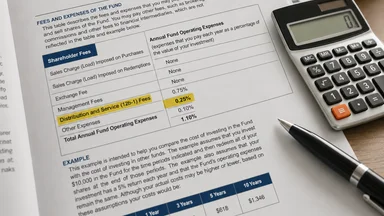
Vesting forfeitures aren't the only hidden cost in 401(k) plans. Fees can also erode returns significantly. Recordkeeping fees typically range from 0.1% to 0.5% of assets annually, depending on plan size. Investment expense ratios for actively managed funds can be 0.5% to 1.5% or more. Some plans also include 12b-1 fees, which are marketing and distribution costs embedded in certain share classes, adding another 0.25% to 1.0%. Combined, these fees can create a drag of 1.5% to 2.5% per year on your balance.
Small plans tend to pay more than large ones. A plan with $1 million in assets might pay 2–3 times the fees of a $100 million plan. This is because fixed costs are spread over a smaller base. For a worker with a $50,000 balance, a 2% annual fee means $1,000 per year in costs, compared to $500 if fees were 1%. Over 30 years, that difference can compound to tens of thousands of dollars. The ETF expense ratio that excludes 0.15% in hidden trading costs is a related issue, as even low-cost funds have trading costs not reflected in the expense ratio.
Fee disclosure is mandated by law, but it's often buried in dense documents. The Department of Labor requires plans to provide a fee disclosure statement annually, but many participants don't read it. A 2023 survey by the American Institute of CPAs found that only 40% of workers could recall seeing their plan's fee disclosure. Even among those who did, few understood the impact. A 1% fee might sound small, but it can reduce your ending balance by 20% or more over a career, according to the Securities and Exchange Commission.
Some plans offer lower-cost index funds, but not all do. If your plan's investment menu is limited to high-fee active funds, you may have few options to reduce costs. In that case, consider lobbying your HR department to add low-cost options, or limit your contributions to the match threshold and invest the rest in a low-cost IRA. The variable annuity fee stack that erased a 7% annual return is a cautionary tale of how layered fees can devastate returns.
Why the Safe Harbor Myth Misses the Point
Safe harbor 401(k) plans require immediate vesting of employer match contributions, which eliminates forfeiture risk for the match. However, only about 30% of plans use this design, according to the Department of Labor's 2025 data. The remaining 70% are traditional plans with delayed vesting. Even within safe harbor plans, employers can still impose vesting on profit-sharing contributions, which are separate from the match. So a safe harbor plan isn't a complete solution.
Employers often avoid safe harbor because it's more expensive. The immediate vesting requirement means the employer cannot recoup match dollars from early leavers. Additionally, safe harbor plans must meet certain contribution formulas, such as a dollar-for-dollar match on the first 3% of pay plus 50 cents on the next 2%, or a non-elective contribution of 3% of pay for all eligible employees. These requirements can increase costs, especially for companies with high turnover. As a result, many employers choose traditional vesting to keep costs down.
Some advocates suggest that workers should treat the match as a bonus, not a guarantee. If you stay long enough to vest, great. If not, don't count on it. This pragmatic approach can help avoid disappointment, but it doesn't address the systemic issue. A better solution might be to require all plans to provide immediate vesting for matches, as some states have proposed. Until then, workers need to be proactive.
Three Ways to Cut Your Vesting Exposure
First, negotiate immediate vesting as part of your job offer. Not all employers will agree, but it's worth asking, especially if you're in a high-demand field. Some companies offer immediate vesting as a recruiting perk. If they won't budge, ask about the vesting schedule and factor it into your decision. A job with a slightly lower salary but immediate vesting could be worth more than a higher salary with a long vesting cliff.
Second, target employers with short vesting schedules. A one-year cliff is much better than a three-year cliff. Some companies, particularly in tech and finance, offer immediate vesting for matches. Others use a one-year cliff. Research the company's benefits before applying. Websites like Glassdoor and Brightscope sometimes include vesting details, but the best source is the plan document, which you can request during the interview process.
Third, roll over old 401(k)s to an IRA to consolidate control. When you leave a job, you can roll over your vested balance to an IRA, where you have more investment options and lower fees. Unvested amounts remain in the plan until you either return or forfeit them. By rolling over, you at least protect what you've earned. Additionally, consider using a Roth IRA as a supplement. Roth IRAs have no employer match, but they offer tax-free growth and no vesting. If your vesting risk is high, it may be better to max out a Roth IRA before contributing beyond the match threshold in a 401(k).
The True Cost of a 401(k) Match at 5% Contribution
Let's run the numbers. Assume a salary of $60,000 and a 5% employer match, so $3,000 per year in employer contributions. Under a three-year cliff vesting schedule, if you leave after two years, you get zero of the $6,000 contributed. Under graded vesting (20% per year), leaving after two years means you keep 40%, or $2,400, forfeiting $3,600. Over a 10-year career with three job changes, the typical worker might forfeit $12,000 to $18,000, depending on timing.
Compare that to an immediate-vesting IRA. If you contribute $3,000 per year to a Roth IRA (assuming you're eligible), you keep every dollar. No forfeiture risk. The trade-off is that you lose the tax deduction of a traditional 401(k), but for many people, the Roth's flexibility and lack of vesting make it a better choice, especially early in a career. The trust fund grantor rule that taxes assets you never touched is a different kind of hidden cost, but it illustrates how obscure rules can impact your finances.
Key Takeaways
Understanding your plan's vesting schedule is crucial. Check whether your plan uses cliff or graded vesting, and know how many years you need to stay to fully own the match. If you plan to change jobs, factor in the value of unvested match dollars when evaluating offers. Consider negotiating for immediate vesting or choosing employers with shorter schedules. For those with high turnover risk, a Roth IRA may be a better vehicle for early-career savings. Finally, keep an eye on fees—they can compound the damage from forfeitures. By taking these steps, you can reduce the hidden costs that erode your retirement savings.
This article is for informational purposes only and does not constitute personalized financial advice. Consult a qualified professional for your specific situation.